
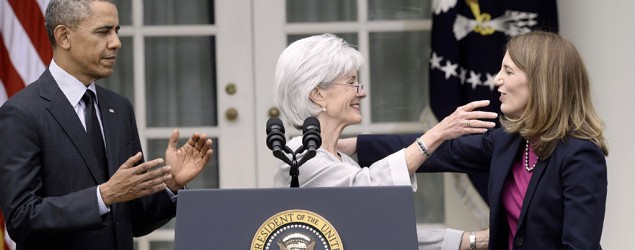
President
Obama will tap budget director Sylvia Mathews Burwell to replace Kathleen
Sebelius. But Obamacare remains a political lightning rod ahead of midterm
elections.
The resignation of Kathleen Sebelius, secretary of Health and Human Services (HHS), marks the end of a turbulent chapter in the launch of President Obama’s signature program, the Affordable Care Act.
News of Secretary Sebelius’s
resignation broke Thursday evening, as did reports that President Obama would
nominate his budget director, Sylvia Mathews Burwell, to replace her. The
Sebelius news comes days after the first open enrollment period for health
insurance under Obamacare had closed.
Sebelius faced harsh criticism for
the disastrous rollout – one in which the Obama administration reportedly came
close to scrapping HHS’s poorly constructed website, Healthcare.gov, and
starting over. She appeared blindsided by the problems that were evident upon
the site’s launch Oct. 1, and she accepted responsibility for her department's
failures.
But, in fact, in congressional
testimony Thursday, Sebelius announced that total enrollment now exceeds 7.5
million, a half million people beyond the administration’s goal for 2014. And
that number continues to rise, as enrollments that were started before the
March 31 cutoff date are completed. The website’s initial dysfunction was
corrected last fall in a frantic effort by outside tech experts and an
emergency manager brought in to solve the problem.
Still, beyond the website issues,
Obamacare remains a controversial policy. And while Sebelius’s departure
removes one political lightning rod from the scene ahead of the November
midterms, the program itself remains a lightning rod. The Republican campaign
mantra is “Obamacare, Obamacare, Obamacare,” as Democrats fight to hold onto
their majority in the Senate.
Sebelius’s resignation, which
Republicans have been demanding for months, is “just going to embolden
Republicans,” David Yepsen, director of the Paul Simon Public Policy Institute
at Southern Illinois University, told Reuters.
The resignation also sets in motion
a succession process that includes Senate confirmation hearings for Ms.
Burwell, which will put not only her but also the entire ACA in the hot seat.
Burwell has been budget director only since April 2013 and went through Senate
confirmation to take that post.
White House officials praised
Burwell’s management skill in acknowledging that she is Mr. Obama’s choice for
HHS.
“The president wants to make sure we
have a proven manager and relentless implementer in the job over there, which
is why he is going to nominate Sylvia,” White House chief of staff Denis
McDonough told The New York Times.
Burwell is a graduate of Harvard
University and Oxford, where she was a Rhodes scholar.
If confirmed, Burwell will have her
work cut out for her at HHS. While Healthcare.gov is now functioning, more or
less, the site will go through extensive upgrades and retooling in preparation
for the next open enrollment period, which begins Nov. 15. In addition,
Insurers will soon be setting rates for next year, as they see who has enrolled
for 2014.
So far, firm data are not publicly
available on the demographic makeup and health status of new enrollees. Most
critical is the percentage of young, healthy enrollees, whose premiums are
needed to offset the cost of covering older, less healthy people. Early
indications show the enrollees may be less healthy than those insured outside
the government-run exchanges.
If the risk pools for those insured
on individual plans lean heavily toward older, less healthy people, insurance
rates may spike, analysts say. Each state’s individual health insurance market
constitutes its own risk pool and consists of people who have bought plans both
inside and outside the exchanges.
The ACA contains risk mitigation
measures, designed to smooth out any imbalances experienced by insurers in the
early years of implementation. But these measures are controversial;
Republicans call them a bailout for the insurance industry.
Burwell will have to muster her
political skills in dealing with Republicans on Capitol Hill, who remain eager
to defund and dismantle Obamacare. Democrats could also pose a challenge,
particularly those who face a reelection fight.
Burwell’s confirmation vote will be
her first test. Last year, the Senate confirmed her on a vote of 96 to 0 as
director of the Office of Management and Budget. But HHS confirmation is likely
not to be so easy. Even if senators have nothing specific against Burwell, the
vote will be seen as a test of opposition to Obamacare. Democrats control the
Senate 55-45 and, last year, changed Senate rules to end a filibuster on
presidential nominees. That means five Democrats can vote against Burwell and still
see her confirmed, with Vice President Joe Biden breaking the tie.
Republicans were quick Thursday
evening to portray Obamacare itself as the problem, not Sebelius.
"Secretary Sebelius oversaw a
disastrous rollout of ObamaCare, but anyone can see that there are more
problems on the way,” Republican National Committee chairman Reince Priebus
said in a statement. “The next HHS secretary will inherit a mess – Americans
facing rising costs, families losing their doctors, and an economy weighed down
by intrusive regulations.”
But some Republicans wished Sebelius
well.
“While we haven’t always agreed,
Secretary Sebelius did the best she could during the tumultuous and volatile
rollout of the law,” Sen. Orrin Hatch (R) of Utah, ranking member of the Senate
Finance Committee, said in a statement.
And one Republican senator, John
McCain of Arizona, sent out words of encouragement to Obama’s pick as
Sebelius’s successor.
“Sylvia Burwell is an excellent
choice to be the next HHS Secretary,” Senator McCain tweeted.
Kathleen Sebelius Resigns As Health Secretary: What It Means For Obamacare
![Kathleen Sebelius Resigns As Health Secretary: What It Means For Obamacare]() Reviewed by Unknown
on
Friday, April 11, 2014
Rating:
Reviewed by Unknown
on
Friday, April 11, 2014
Rating:


No comments: